Fifteen VBR members and vistors on Howard's 8.9 mile, figure-of-eight walk starting in the car park at the rear of the Dovecote Inn, also the location of the very informative Laxton Visitor Centre.
The first loop took us through and around Egmanton Wood where we had a brief coffee stop overlooking the village of Egmanton. Then onwards to visit the site of Laxton Castle which was the main seat of power for Nottinghamshire in the late 12th and early 13th centuries. King John often stayed here. After returning to Laxton, we had lunch at the restored pinfold just in front of the Dovecote Inn.
The second loop took us along little-used footpaths that skirted around the South Field and then Mill Field before returning via the village fish ponds (disused) and the impressive St Michael's Church with its collection of dramatic gargoyles.
Thanks Howard, Val and Paul for the photos, route and explanations.
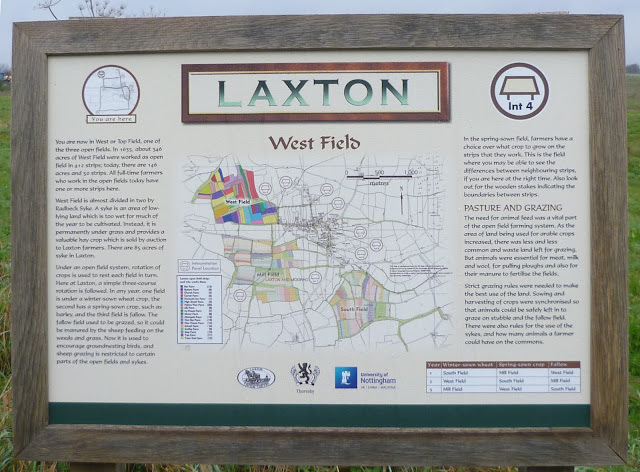 |
| Laxton retains a significant part of the medieval open field system. Fields, divided into strips, were farmed in common among the landowners of the village. Today, there are three open fields remaining; the Mill Field, the South Field and the West Field. In 1655, about 346 acres of West Field were worked as open fields in 412 strips. |
More information about Laxton and particularly its farming heritage can be found at http://www.laxtonvisitorcentre.org.uk/index.htm
 |
| Leader's briefing at the start |
 |
| The sort of thing we gentlemen do for ladies |
 |
| Egmanton Wood |
 |
| Round Egmanton Wood |
 |
Laxton Castle
The remains of a medieval castle built by a great Norman landowner Robert de Caux. In the 12th century, he was appointed hereditary Keeper of Sherwood Forest. The size of the castle reflected this important role, and many royal visitors were received here.
In the 1230s, the castle and responsibility for Sherwood Forest passed to the Everingham family. In 1286, Robert de Everingham was imprisoned at Nottingham for trespass on the king's deer – he had been poaching.
The castle fell out of use during the 14th century. When the Roos family acquired the manor of Laxton in the mid-15th century, the old castle was no longer a desirable place to live. |
 |
| On top of the earthworks of Laxton Castle |
 |
| St Michael's Church, Laxton first time round |
 |
| The pinfold as you see it now is a relatively recent construction. There was a pinfold adjacent to this spot up until 1897, when a replacement was built across the road. Then, in 1969, the pinfold was rebuilt in its present position. No fines have been collected since the 1930s, though a pinder is still appointed by the manor court (now one person acts as both Pinder and Bailiff). |
 |
| Our Leader, appointed Pinder for the day |
 |
| Bridge over Moorhouse Beck, draining eastwards to the Trent 5 miles away |
 |
| Lincoln Cathedral |
 |
| Just south of Laxton and along the valley of the local stream are nine fishponds made by digging out earth from the hillside and then banking it up on the streamside at each end |
 |
| Gargoyle in St Michael's Church |


